

Signal Isn’t Alpha: Returns Come from Fundamentals
"We only invest in companies with 'Stanford' founders/ Large Asset Management Co - it's about quality and pedigree, you know."

I heard this exact phrase twice recently, during 2025 SP Tech Week. Once from a VC partner at an event, and again during a call with a Silicon Valley-based fund. Smart investors, experienced GPs, all nodding along to the same comfortable narrative about "Consensus Metrics."
What struck me wasn't the sentiment - talent clearly matters. What fascinated me was how this creates one of the most interesting arbitrage investment opportunities I've seen.
You know the drill Right? Get in!
The Psychology Behind Deal Selection Bias
As the Airborne annual meeting approaches, I was analyzing our portfolio performance. Not too shabby, our 2021 vintage achieved ~1.44x TVPI with 15.8% IRR (in USD) - performance that outpaced many funds chasing "marquee deals" from the same vintage. But the numbers alone weren't what intrigued me most. It was the process.
I would say that winning investments came from focusing on fundamentals over pedigree. Companies solving real problems with sustainable unit economics, led by operators who understood their markets deeply. Meanwhile, several "hot deals" we saw later struggled despite their founders' impressive credentials, perhaps because the market timing wasn't right or the fundamentals weren't there.
Takeaway: Good company is not a synonym of good investment.
This reminded me of a fascinating psychology experiment from 1973. Stanford psychologist David Rosenhan sent healthy individuals to psychiatric hospitals with fake symptoms. Once labeled "mentally ill," every normal behavior was reinterpreted through that initial diagnosis.
The venture capital parallel is almost too perfect:
Once a fund achieves "institutional grade" status, every data point gets filtered through that lens:
Mediocre net returns become "sophisticated risk management in competitive markets"
Complex fee structures become "alignment mechanisms for premium outcomes"
Limited transparency becomes "protecting proprietary competitive advantages"
Slow deployment becomes "patient capital for optimal entry timing"
Meanwhile, newer managers with stronger fundamentals face the reverse interpretation:
Superior net returns become "unsustainable early performance"
Transparent reporting becomes "trying too hard to prove themselves"
Streamlined fees become "you get what you pay for"
Dynamic deployment becomes "undisciplined capital allocation"
The amusing part? This creates systematic mispricing that benefits LPs smart enough to run the actual numbers.
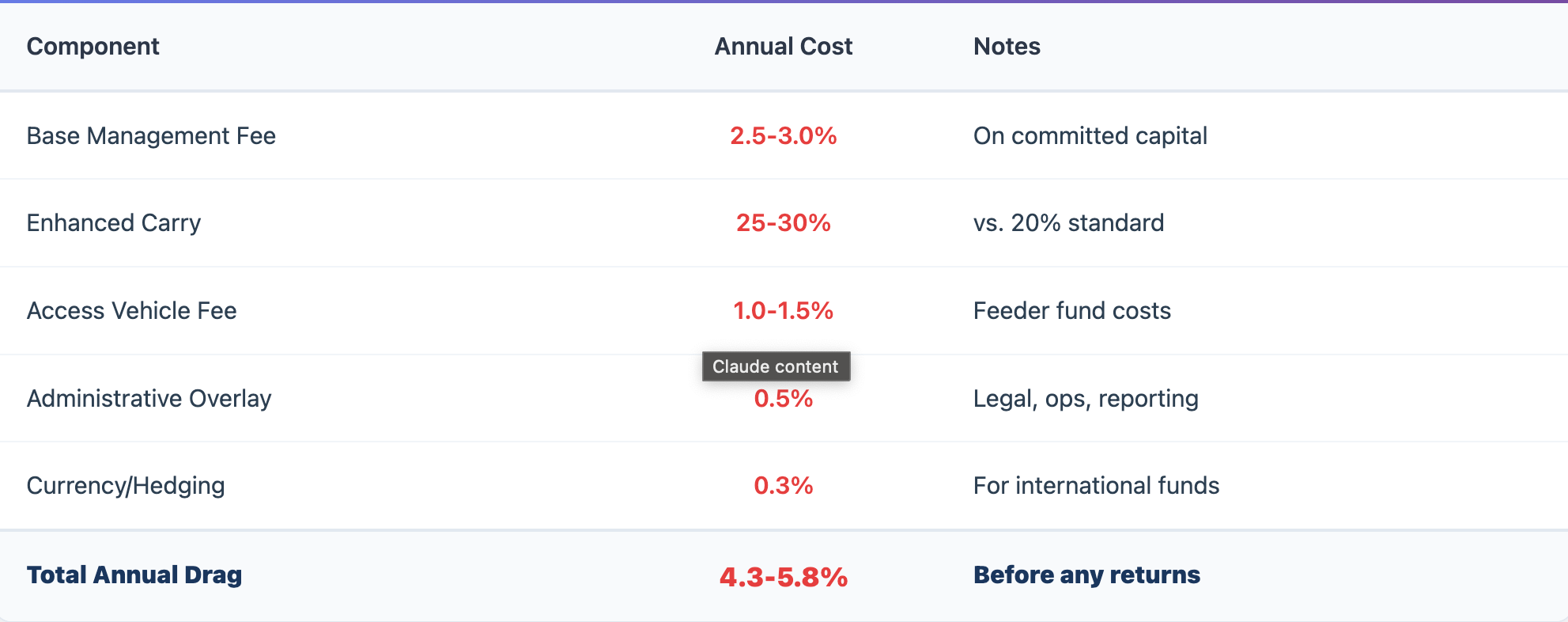
The Total Cost of "Institutional Quality"
Let's examine what accessing established managers actually costs when you add up all the layers:
Anatomy of Premium Manager Access
Typical "Institutional Grade" Investment Structure:
Alternative High-Quality Manager Structure:
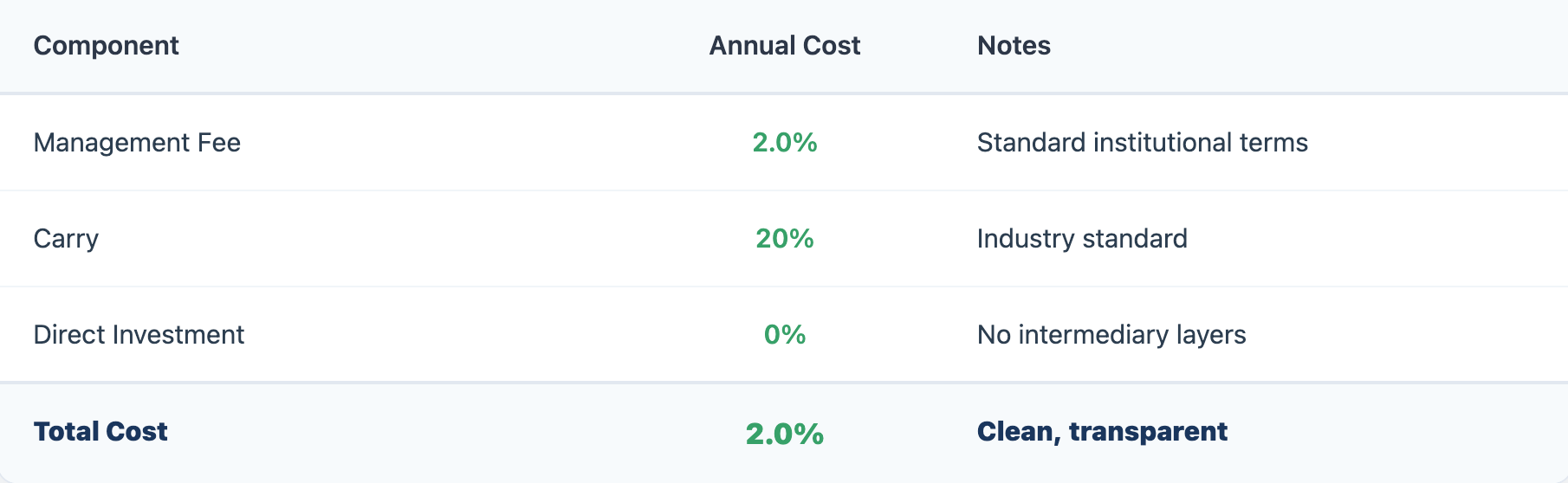
The mathematics are straightforward: Even if the "premium" manager outperforms by 150 basis points annually, you're looking at neutral net returns after the complete fee stack.
Over a 10-year investment horizon, that compounds to approximately $180,000 less wealth creation per $1M invested. Which raises interesting questions about what "institutional quality" actually means for beneficiaries.

Pattern Breaking vs. Pattern Matching in Deal Selection
Recently, I came across a brilliant insight from James Sedgwick-Heath about venture allocation: "Pattern-breaking vs pattern matching... Contrarian > consensus. But no one wins on the right."
This perfectly captures what I've observed in startup selection:
Pattern Matching (Consensus Deals):
Founder credentials that impress investment committees
Hot sectors with obvious TAM narratives
Multiple VCs competing for allocation
Higher valuations, lower ownership
Result: Lower returns despite higher initial confidence
Pattern Breaking (Contrarian Deals):
Domain experts who lived the problem they're solving
Unsexy but profitable business models
Limited VC competition due to "boring" narratives
Better entry pricing, meaningful ownership
Result: Superior risk-adjusted returns
What I've Learned from a decade Investing
The founders who create sustainable value share characteristics that have nothing to do with their educational pedigree:
Deep market understanding: They lived the problem for years, not months
Execution focus: They ship products and iterate based on real customer feedback
Unit economics literacy: They know their numbers without consulting slides
Capital efficiency: They build sustainable businesses regardless of fundraising cycles
At Airborne, we compete on this fundamental analysis rather than founder brand recognition. It consistently reveals opportunities that credential-focused investors miss.
The Behavioral Arbitrage Opportunity
The venture industry has developed sophisticated marketing capabilities while maintaining surprisingly basic analytical transparency standards. This creates genuine arbitrage opportunities for LPs willing to prioritize mathematics over social proof.
The opportunity: Superior managers operating at reasonable fee structures while institutional capital chases the same branded names, trying to find their "IBM."
The methodology: Systematic analytical frameworks that separate substance from perception in manager evaluation.
The outcome: Meaningfully better net returns for beneficiaries through disciplined capital allocation.
Understanding the Rosenhan Effect reveals where other people's pattern matching creates your pattern-breaking alpha opportunities. The mathematics are clear. The psychology is predictable.
The question becomes: Are you ready to optimize for contrarian fundamentals rather than consensus validation?
I'd love to continue this conversation. Whether you're a fellow GP thinking about deal selection or a founder building something meaningful, there's always more to learn from each other's perspectives.
This analysis draws from practical experience across 70+ direct investments and building Airborne Ventures in the B2B software ecosystem. The patterns apply broadly, but every investment requires thoughtful adaptation to specific circumstances.